The Athanor Method is how we build commercial-grade software: written specifications, verification in layers, and human judgment at every gate. You own the code, the documentation, and the record of every decision behind it.

Building digital products.
Perfecting the Athanor Method.
Leading in the Post-Coding Era.
Explore Athanor
WHY THE METHOD EXISTS
Most firms are treating AI as a productivity tool bolted onto how they already work.
We think that misreads the shift.
The tooling has changed permanently. Agents do the execution work. What used to take a senior engineer a week takes an afternoon. The bottleneck is no longer keystrokes.
The new bottleneck is judgment: which specification is right, which output is trustworthy, which decisions defensibly follow from what came before. Those decisions are not something software can make for you. They require humans, and they require a discipline that makes every one of them traceable.
The Athanor Method is that discipline: our systematic approach to human-agentic hybrid teams.
It is not a tool. It is not an add-on to how we used to work. It is built for the way engineering happens now: humans hold judgment, agents do the execution, and every decision along the way becomes part of the record.
WHAT YOU GET
Every Athanor engagement produces customer-ready product and the record that makes it maintainable.
Both are yours the day we ship.
Your Product
A commercial-grade digital product built to your specification. Software, hardware, or both. Working, integrated, and in production: not a prototype that survives a demo.
Your Specifications
A signed, versioned record of what was built and why. The reasoning behind every non-obvious decision, captured while it was made rather than reconstructed later.
Your Phase Approvals
Every phase transition, signed off by a named person against a defined criterion. Evidence that the work advanced deliberately, not by assumption.
Your Quality Evidence
Three layers, each documented: deterministic checks, second-pass evaluation against the specification, and human review. Proof the product does what it was designed to do.
You keep the product and the reasoning behind it. Maintenance, handoff, or a future rebuild starts from the record, not from someone’s memory.
Our custom Claude plugin guides every engagement under the Method: the same systematic approach, on every project, no exceptions.
THREE WAYS WE WORK
Where you start depends on where your codebase is today.
Every engagement, whatever the starting point, produces the four deliverables above.
Prima
A new product, built under the Method from the first requirement forward. The specification, the phase approvals, and the quality evidence accumulate alongside the code as it is written. Prima is where the Method delivers its full value: the record is native to the work, not reconstructed after.

Assay
A structured read of an existing codebase and the decisions behind it. Produces the record that should have existed all along: architecture, dependencies, known issues, risk areas, the reasoning behind non-obvious choices. Some clients stop after the Assay because the record itself is what they needed. Others use it as the foundation for what comes next.
Transmutation
The modernization build that follows an Assay. Moves a system from a known, documented state to a new one, deliberately. Modernizing without an Assay means guessing at what the current system does. Transformation starts from evidence.
Not sure where to begin? A short call is enough for us to point you at the right one.
PRINCIPLES THE METHOD HOLDS TO
The four deliverables above are what an engagement produces.
These are the principles that make them trustworthy:
Agents do not grade their own work.
The separations that keep human teams honest apply to agents. The system that writes the code is not the system that reviews it. Reviewers see the output cold, without the assumptions the builder made.
Verification happens in layers.
Deterministic checks catch what is measurable. A second-pass evaluation asks whether the output actually satisfies the specification. A human review is the last layer, not the first. Each layer catches what the one before it cannot.
The toolchain is not the Method.
The specific tools that meet the Method's requirements change as the industry changes. What holds constant is the discipline. We use whatever tools best serve the work: today's stack will not be next year's, and neither is the Method.
PROOF OVER PROMISE
The Method is refined through our own engagements before it appears in yours.
Recent examples of client engagements:
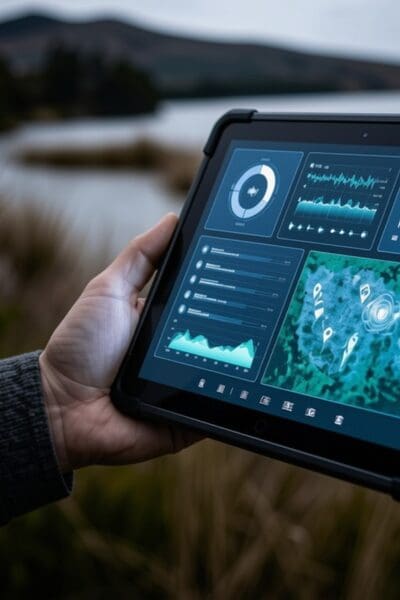
From Dark Devices to Connected Innovation
From Dark Devices to Connected Innovation
Read More
App Modernization in Weeks, Not Months
App Modernization in Weeks, Not Months
Read MoreMore engagements, and the record behind them, are available under NDA in a first call.
What we’re writing about it:
The Post-Coding Era: Software Costs 50% Less, and Not for the Reason You Think
The Post-Coding Era: Software Costs 50% Less, and Not for the Reason You Think
Read More
The Post-Coding Era: Hard Decisions About People
The Post-Coding Era: Hard Decisions About People
Read More
The Post-Coding Era: Software Development Trade Skills Are Being Automated Out of Existence
The Post-Coding Era: Software Development Trade Skills Are Being Automated Out of Existence
Read MoreThe Post-Coding Era is here. The Method is how we build for our clients now, and how the record we leave behind makes what comes next easier.
Frequently Asked Questions
Why hire a digital product studio instead of hiring in-house?
Hiring a full product team internally takes months and locks in a specific way of working at a moment when the practice itself is changing quickly. A digital product studio brings a team that already works this way, delivers under a defined engagement, and hands everything back at the end. Your team can then extend the work, or hire against a known shape rather than a guess.
How does CODE Éxitos work with our existing engineering team?
You have options. We can lead the full build, or work alongside your engineers on a shared codebase. Either way, your team stays close to the work: they see the specification, the phase approvals, and the reasoning behind every non-obvious decision. When we ship, they can extend what we built without us.
What kinds of projects do you take on?
Experience shows projects fit one of three types. Prima is a new product built under the Method from the first requirement. Assay is a structured read of an existing codebase. Transmutation is the modernization build that follows an Assay. We work across software, hardware, and the systems that combine the two.
What industries do you work in?
Mobility and automotive, industrial automation and manufacturing, transportation and logistics, and agriculture. Cyber-physical products, where software, hardware, and sensors have to work as one system, are where we build the most depth. We also work selectively in energy, aviation, and consumer electronics when the engagement is a good fit for the Method.
How is CODE Éxitos different from a typical software agency?
Most firms optimize for shipping what was scoped. We optimize for what the code becomes after we leave: how it reads, how it integrates, how easily your team can extend it. The Athanor Method is the discipline that holds that standard steady across every phase and every engagement, so quality doesn’t ride on any single person having a good week.
How does pricing work?
We work on a Business Value, Fixed-Frame model. We scope the engagement, agree on deliverables and timeline, and quote a fixed price. When scope shifts, and it does, the model adapts without change orders or renegotiation. You always know what you’re paying, and what you’re getting.
Do I own the code and intellectual property?
Yes. You own everything: the code, the documentation, the architecture decisions, and all supporting artifacts. Nothing is held hostage. Nothing requires our ongoing involvement to use or modify.
What happens after launch?
Every engagement includes a warranty period. We stand behind the quality of what we ship. Clients who want ongoing support, feature development, or product evolution engage us on a separate agreement. Many do. The transition is direct because the team already knows your product, your codebase, and your standards.
Do you work with companies outside the United States?
Yes. We work with companies in the United States, Canada, and Europe. We’re structured for remote collaboration across time zones, and every engagement runs through the Method and the same quality standards regardless of where the client is based.
What's the first step?
Fill out the contact form and give us the short version of what you’re working on. We’ll schedule a call, spend time with your team understanding the problem, and send you a product strategy brief. No cost, no commitment. If it’s a fit, we can start in as little as two weeks.